


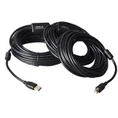


The USB 3.1 specification is divided into two versions: USB 3.1 Gen 1 (USB 3.0) and USB 3.1 Gen 2. Here are the main differences between them:
1. Data transfer rate:
- The transfer rate of USB 3.1 Gen 1 is 5Gbps, or 500MB/s.
- The transfer rate of USB 3.1 Gen 2 is 10Gbps, or 1250MB/s.
2. Power delivery capability:
- The maximum power delivery of USB 3.1 Gen 1 is 5V/0.9A (4.5W).
- The maximum power delivery of USB 3.1 Gen 2 is 20V/5A (100W).
3. Interface shape:
- The interface shape of USB 3.1 Gen 1 is the same as USB 2.0, usually displayed as a square pin.
- The interface shape of USB 3.1 Gen 2 is the same as USB 3.0, usually displayed as a flat reverse hook pin.
4. Compatibility:
- USB 3.1 Gen 1 is fully compatible with USB 2.0 devices.
- USB 3.1 Gen 2 is compatible with both USB 2.0 and USB 3.0 devices, but the transfer speed will be limited by the slowest device.
In short, USB 3.1 Gen 2 provides higher data transfer speeds and greater power transfer capabilities than USB 3.1 Gen 1. If you need to connect high-speed external storage devices, high-performance hardware, or high-power devices, it would be more appropriate to choose a USB 3.1 Gen 2 interface. However, if your devices are mainly products from the USB 2.0 era, then USB 3.1 Gen 1 may be a more practical choice.