

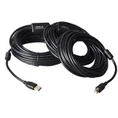


Twisted pair (TP) is a common wiring project in the most commonly used transmission medium, generally by the two 22 ~ 26 insulated copper wire intertwined, "twisted pair" name is the resulting The It is characterized by cheap, so it is widely used, such as our common telephone lines and so on. It is used and RJ45 crystal head connected.
Twisted pair can be divided into unshielded twisted pair (UTP) and shielded twisted pair (STP).
The outer layer of the shielded twisted pair cable is wrapped by aluminum platinum to reduce the radiation, but it can not completely eliminate the radiation, the shielded twisted pair price is relatively high, the installation is more difficult than the unshielded twisted pair cable.
Unshielded twisted pair cable has the following advantages: Unshielded jacket, small diameter, save space occupied; Light weight, easy to bend, easy to install; near-end crosstalk to minimize or eliminate; with flame retardant; And flexibility for structured cabling.
Twisted pair common models are as follows:
A class of lines (CAT1): mainly used for transmission of voice (a class of standards mainly used for the early eighties before the telephone cable), different from the data transmission.
Type 2 cable (CAT2): transmission frequency of 1MHZ, for voice transmission and the maximum transmission rate of 4Mbps data transmission, common in the use of 4MBPS specification token transfer protocol of the old token network.
Three types of cable (CAT3): transmission frequency 16MHz, for voice transmission and the maximum transmission rate of 10Mbps data transmission is mainly used for 10BASE - T, ANSI and EIA / TIA568 standard specified in the cable.
Four lines (CAT4): transmission frequency of 20MHz, for voice transmission and the maximum transmission rate of 16Mbps data transmission is mainly used for token-based LAN and 10BASE-T / 100BASE-T.
Category 5 cable (CAT5): transmission frequency of 100MHz, for voice transmission and the maximum transmission rate of 100Mbps data transmission, mainly for 100BASE-T and 10BASE-T network. This is the most commonly used Ethernet cable, this type of cable increases the winding density, the jacket is a high quality insulation material.
Ultra-Category (CAT5e): transmission frequency of 100MHz, mainly for Gigabit Ethernet (1000Mbps). (ACR) and signal-to-noise ratio (StructuralReturn Loss), a smaller delay error, performance has been greatly improved, with less attenuation, less crosstalk, and a higher attenuation and crosstalk ratio (ACR) and signal to noise ratio (StructuralReturn Loss).
Category 6 (CAT6): transmission frequency of 250MHz, the most suitable for transmission rate higher than 1Gbps applications, mainly for Gigabit Ethernet (1000Mbps). Six twisted pair in the shape and structure with five or super five twisted pair have a certain difference, not only increased the cross of the skeleton, the twisted pair of four pairs of lines were placed in the cross Groove, and the diameter of the cable is also thicker.
Super 6 or 6A (CAT6A): the transmission frequency is 200 ~ 250 MHz, the maximum transmission speed can reach 1000 Mbps, mainly used in Gigabit networks. The super six lines are an improved version of the six lines, as well as an unshielded twisted pair cable as specified in the ANSI / EIA / TIA-568B.2 and ISO 6 / E standards, in crosstalk, attenuation and signal Such as a greater improvement.
Seven lines (CAT7): transmission frequency of at least 500 MHz, the transmission rate of up to 10 Gbps, it is mainly to meet the 10 Gigabit Ethernet technology applications and development. The line is ISO 7 class / F standard in the latest shielded twisted pair.

Super five and six types of cable line what kind of good network cable
Apr 06, 2017Leave a message
Send Inquiry