




The premise of knowing something is to perceive it. First of all we have to know eSATA and USB3.0 interface, respectively, what kind of. USB3.0 appearance and USB2.0 and no difference, and in order to distinguish between these two different interfaces, the industry provides the USB3.0 interface color must be blue. In addition, USB2.0 only has four gold finger, and USB3.0 there are nine.

This picture is very intuitive to tell us that the red is eSATA interface, while the blue is USB3.0 interface
So what does the eSATA interface look like? As shown above, in the HDMI and USB3.0 interface between the red interface is eSATA interface (eSATA interface, any color, and no mandatory standard).

Mobile hard disk with 2.5-inch traditional mechanical hard drive, the speed limit of less than eSATA (SATA2) standard
Transmission speed, USB3.0 has 5Gbps high bandwidth, converted to the actual value of the theory was 500MB / S. ESATA with SATAII, with 3Gbps transmission speed, converted after the theoretical transmission speed of 300MB / S. Seemingly USB3.0 compared to eSATA interface has an absolutely overwhelming advantage, but taking into account the actual situation is not the case. Because in the day we most of the use of 2.5-inch mechanical hard drive as a mobile hard disk (with large-capacity SSD as a mobile hard disk burner is not in the scope of the discussion), and now even the fastest 3.5-inch mechanical hard drive, transmission speed is still no breakthrough 200MB / S. Since the highest speed is also eSATA (SATA2) 300MB / S below, the comparison has a meaning.
● ESATA and USB3.0 interface transmission actual combat test
This test we used two test software, respectively, CrystalDiskMark and HD Tune. In CrystalDiskMark, the hard disk read and write speed will be intuitive rendering. In the HD Tune, we focus on testing a certain size of the file simulation copy of the measured

ESATA TEST

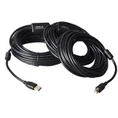
USB3.0 cable
CrystalDiskMark from the test results, we can see, eSATA read and write speed slightly lower than USB3.0, but the gap is very small, can be counted as the same level.

ESATA

USB3.0
In the HD Tune test file benchmark project, eSATA is still comparable with USB3.0. We 2000MB length of the file as a test object, USB3.0 interface in the read speed relative to the eSATA interface slightly prevail. In the 4KB single random and multiple random, eSATA interface IOPS value has maintained a USB3.0 interface leader.
● Summary: have their own advantages, USB3.0 big trend
In this test, we are not on eSATA and USB3.0 these two interfaces have a very intuitive understanding of the performance of it? In the actual test speed, the two comparable, it is not that the two interfaces are similar to the practicality, and when we buy equipment, as long as the choice of equipment with one of the interface can it?
Really not also. In the choice of interface, we need to consider a lot of things. First, the eSATA cable only has the effect of transmitting data, it is not able to power the device. In other words, if we want to use eSATA mobile devices, in addition to eSATA cable to link, but also to link the power cord. Two wires greatly increased the use of mobile devices cumbersome, and USB3.0 is completely without this problem. And USB3.0 USB2.0 only provide 0.5A power supply on the basis of an increase of 0.5A, into the current 1A, power supply capacity increased significantly.
In the mechanical hard disk speed bottlenecks have not yet broken before, eSATA and USB3.0 interface at the same time the speed of comparable. But from a variety of factors and future trends, USB3.0 interface will be more and more strong, and eSATA interface is likely to become history. There are four reasons: First, eSATA need a separate external power supply, USB3.0 is not required. Second, US3.0 bridge chip will be increasingly advanced, as much as possible to reduce the transmission speed loss. Third, USB3.0 USB2.0 can not solve the same time copy and read the restrictions, the successful realization of duplex data transmission. Finally, USB3.0 up to 5Gbps bandwidth compared to eSATA 3Gbps has a clear advantage, and in the future development of hard disk technology, we seem to be able to foresee the mechanical hard drive speed break eSATA (SATA2) limit.